
Why Do Garage Door Springs Matter So Much?
Most homeowners never think about their garage door springs until something goes wrong. That is understandable — springs are hidden away above the door, doing their job quietly in the background. But they are doing an enormous amount of work. Every time your garage door opens, the spring stores energy and releases it to counterbalance the weight of the door, which can range from 130 to over 350 pounds depending on the size and material. Without functioning springs, the opener motor alone cannot lift the door safely, and the entire system is compromised.
Understanding the warning signs that your springs are failing can save you from an inconvenient breakdown, protect the rest of your garage door system from damage, and keep your household safe. In Simcoe County and York Region, where garage doors face the additional stress of extreme temperature swings, spring failure is one of the most common service calls of the season.
Springs are the muscle of the garage door system. When they are healthy, everything else works the way it should. When they start to fail, you feel it in the door’s performance long before they actually snap. Most of the time, there are clear warning signs if you know what to look for.
Ilan Kuchuk, Founder, Spring Tech Garage Doors
What Types of Springs Does Your Garage Door Have?
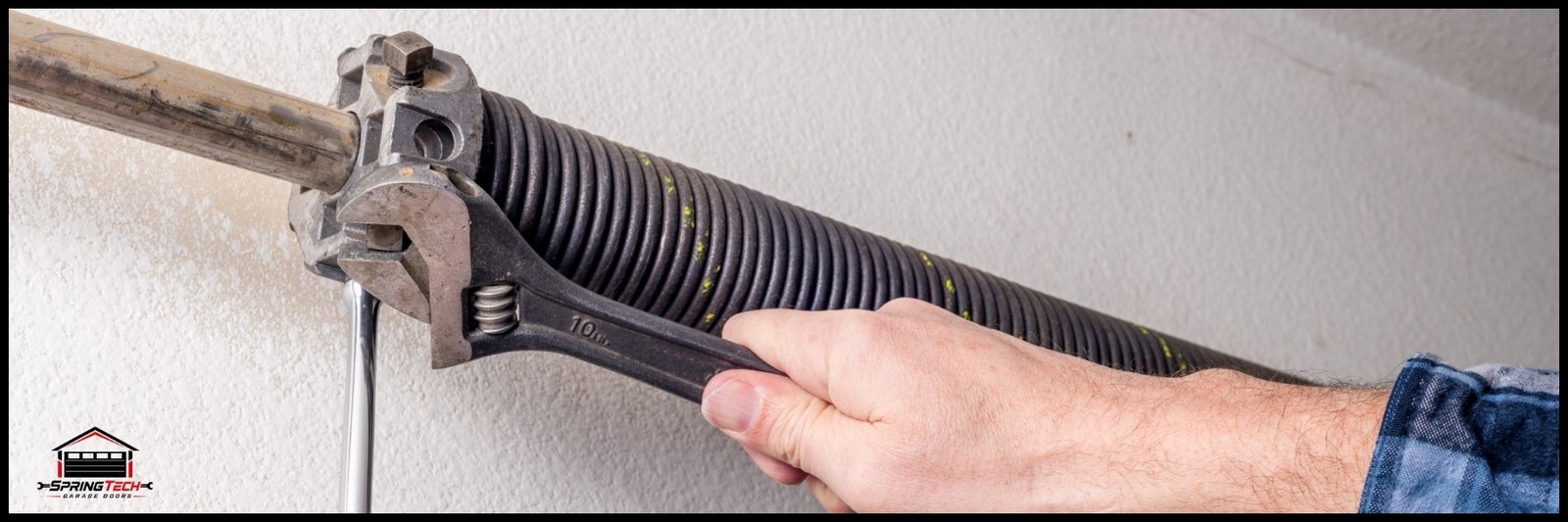
Before diving into the signs of failure, it helps to understand which type of springs you have. Most modern residential garage doors use torsion springs — a horizontal spring or pair of springs on larger doors mounted on a metal shaft directly above the door opening. Torsion springs twist to store and release energy and are rated for approximately 10,000 cycles, which translates to roughly 7 to 10 years of average residential use.
Older homes across Simcoe County and York Region are more likely to have extension springs — a pair of springs running along the horizontal tracks on either side of the door. Extension springs stretch and contract with each cycle and tend to wear out faster than torsion springs, averaging 5,000 to 10,000 cycles. If your home was built before the mid-1990s and the springs have never been replaced, extension springs are worth checking carefully. High-cycle torsion springs, rated for 25,000 to 50,000 cycles, are also available and worth considering as an upgrade if you are replacing springs in a high-use household.
What Are the Clear Signs That Your Spring Needs Replacing?
The door feels heavier than it used to. This is one of the most reliable early indicators. Try disconnecting the opener by pulling the red emergency release cord and lifting the door manually to about waist height. A properly balanced door with healthy springs should hold its position when you let go. If it drops quickly, the springs are losing tension and the opener has been compensating — which also accelerates wear on the opener, cables, and pulleys.
There is a visible gap in the spring coil. Torsion springs sometimes break cleanly, leaving a clear gap in the coil that is visible from ground level. If you see daylight through the spring, it has failed completely and the door should not be operated until the spring is replaced. Never attempt to open or close a door manually when the spring is broken — the full weight of the door is unsupported and it can drop suddenly.
The door opens unevenly or jerks during movement. When one spring in a two-spring system fails or weakens before the other, the door no longer lifts evenly. You may notice one side rising faster than the other, or the door seeming to pull to one side. This uneven movement stresses the cables, tracks, rollers, and the opener, and accelerates wear across the entire system.
You hear a loud bang from the garage. A snapping torsion spring sounds like a firecracker going off. If you hear an unexplained loud bang, particularly when the door is in motion or just came to rest, check the spring immediately before using the door again.
The loud bang is the one people notice, but the early signs are subtler. The door that feels a bit heavier, the slight hesitation when it opens, the opener that sounds like it is working harder than it used to — these are all the spring telling you it needs attention. Catching it at that stage means a planned replacement rather than an emergency call.
Ilan Kuchuk, Founder, Spring Tech Garage Doors
Does Central Ontario’s Climate Affect How Fast Springs Fail?
Absolutely. Metal springs expand and contract with temperature — in Barrie, where overnight lows can reach -20°C and below in January, the metal in a torsion spring contracts significantly compared to a summer day. This thermal cycling, repeated over hundreds of freeze-thaw events across a door’s lifetime, fatigues the metal progressively. Rust and corrosion from road salt tracked into the garage accelerate that fatigue further, weakening the spring from the outside in.
A spring that might last 10 to 12 years in a milder climate can reach end of life in 7 to 8 years in Central Ontario if it is not regularly lubricated and maintained. For homes in lakeshore communities near Lake Simcoe or Georgian Bay, elevated moisture levels add corrosion pressure on top of the thermal cycling.
If your home was built during Barrie’s early 2000s growth boom or Bradford’s rapid expansion of the same period, your original springs are now in the 20 to 25 year range — well past their expected service life regardless of how well-maintained they have been. At that age, planning a replacement proactively makes far more sense than waiting for a failure. Professional spring replacement is the right next step for any spring showing signs of age or wear.
Why Is Garage Door Spring Replacement Almost Never a DIY Job?
Garage door springs are under enormous tension — enough to cause serious injury if they release suddenly and unexpectedly. Torsion springs in particular are wound tightly on a metal shaft, and improper handling of the winding bars used to adjust tension is one of the most common causes of serious garage door injuries among homeowners attempting DIY repairs. The Door and Access Systems Manufacturers Association consistently warns against homeowner spring adjustment or replacement, and virtually every professional in the industry agrees.
Beyond the safety risk, spring replacement requires matching the correct spring specifications to the door’s weight, height, and track configuration. An incorrectly sized spring will either fail to balance the door properly or create dangerous excess tension. A professional technician measures the door, identifies the correct spring specifications, and installs and tensions the spring correctly — protecting the door, the opener, and the household.
I say it on every call where springs come up — this is not a DIY repair. The tension involved is serious, and the injury risk from a spring that releases unexpectedly is real. It is one of those situations where calling a professional is not just convenient, it is genuinely the right decision for safety. The cost of the repair is not worth comparing to the cost of getting hurt.
Ilan Kuchuk, Founder, Spring Tech Garage Doors
Should You Replace Both Springs at Once?
If your garage door has two springs and one fails, replacing both at the same time is almost always the right call. Both springs are the same age and have experienced the same number of cycles and the same environmental stress. If one has failed, the other is likely close behind. Replacing only the broken spring means a second service call in the near future. Replacing both at once is more cost-effective and ensures the door is properly balanced with matched springs.
This logic also applies when upgrading from standard springs to high-cycle springs. If you are going to have a technician replace your springs anyway, investing in high-cycle springs at the same time extends the next replacement interval significantly — particularly valuable for high-use households or properties in Simcoe County’s demanding climate.
Replacing one spring is technically possible but rarely the right recommendation when both springs are the same age. The second spring has the same wear, the same number of cycles, the same exposure to cold and salt. We always have the conversation with the homeowner, but most of the time replacing both is the practical choice and they appreciate the honesty.
Ilan Kuchuk, Founder, Spring Tech Garage Doors
Spring Tech Garage Doors provides fast, professional garage door spring repair and replacement for homeowners across Simcoe County and York Region. If your door is showing any of the signs above, contact us to schedule a same-day or next-day inspection before a failing spring becomes a broken one.